Can what you eat affect your depression?
Depression is one of the most common mental health conditions in the world, and for many people the usual treatment with medication and therapy sadly does not work well enough. When someone has tried at least two kinds of depression medication without getting sufficiently better, it is called treatment-resistant depression. It often weighs heavily on daily life.
But what if diet could play a role in treatment? In 2026, a research team from the University of Oxford published the first well-controlled trial of exactly this question in the respected journal JAMA Psychiatry.
In short: 88 adults with treatment-resistant depression followed either a keto diet or a comparison diet for 6 weeks. Both groups improved clearly, and the keto group slightly more, but the difference was smaller than what the researchers had set in advance as the smallest change people can notice, and after 12 weeks it could no longer be told apart from chance. Pooled analyses of other trials, whose participants did not necessarily have depression, find anything from no effect to a modest improvement. Keto is not a replacement for treatment, but it may be a supplement under a doctor's guidance.
What did the trial show?
In the trial, led by Gao and colleagues, 88 British adults aged 18 to 65 with treatment-resistant depression were randomly assigned to either a keto diet or a comparison diet for 6 weeks. All had at least moderately severe depression at the start, measured with the PHQ-9 questionnaire, which runs from 0 to 27 points, where a high score means many symptoms. On average they scored 19.5 points.
The keto diet has very little carbohydrate (in the trial, under 30 grams a day), moderate protein and a lot of fat. It gets the body to switch from running on sugar (blood sugar) to burning fat and making ketone bodies. That state is called ketosis.
The comparison diet meant eating one extra serving of fruit or vegetables a day and using plant oils instead of saturated animal fat. The keto group got three prepared meals a day plus snacks for free for the 6 weeks, or food vouchers if they preferred to cook for themselves, while the comparison group got smaller food vouchers. Both groups had a weekly session with a dietitian or trained coach.
What the Oxford trial showed
Results after 6 weeks
Both groups improved clearly, but the keto group did a little better. Their score fell by 10.5 points on average versus 8.3 points in the other group. The difference of 2.18 points was right at the edge of statistical significance, meaning right at the point where it can be told apart from chance. It was also smaller than the 5 points the researchers had set in advance as the smallest change people can notice.
After 12 weeks the difference was almost the same, 1.85 points, but now so uncertain that it could be down to chance. The support and the free food stopped after 6 weeks, and by week 12, 48% of the keto group had given up the diet completely. The researchers concluded that keto had an effect on mood after 6 weeks, but that it is uncertain how much it matters in practice, because the difference was modest.
What does the broader research say?
Other randomized trials of keto and other low-carb diets, where chance decides who gets which diet, were not necessarily done in people with depression. Two meta-analyses, which combine many single studies to give a more reliable picture, have looked at them, and they point in different directions.
The first, published in 2026 in the same journal as the Oxford trial, is by Janssen-Aguilar and colleagues. It went through 50 studies with a total of 41,718 participants, but it included every kind of study, including surveys that measure at a single point in time and a few individual case reports. The large number of participants therefore says nothing about the effect. The estimate of the effect rests on 10 randomized trials that compared keto with another diet. The abstract does not say whether the participants had depression.
Across the 10 randomized trials, keto was linked to a modest improvement in depressive symptoms, mostly in the studies that measured participants' ketones and in participants without obesity. The link with ketone measurement may suggest that ketosis itself matters, but the Oxford trial could not confirm it: there, participants' urine ketone levels were not related to how much they improved. For anxiety, the meta-analysis found no clear effect.
The second, a meta-analysis of 30 randomized trials with 1,781 participants (International Journal of Food Sciences and Nutrition, 2025), found no effect of low-carb diets, not necessarily keto, on mood or depression. For treatment-resistant depression, the evidence so far rests on the 88 people in the Oxford trial.
Why might keto affect depression?
A 2020 review by Ricci and colleagues in Reviews in the Neurosciences points to several possible explanations. The authors themselves call them hypotheses, built on animal studies and on what is known from treating epilepsy, not on trials in depression. Think of them as different dials that keto may turn in the brain:
- More energy in the cells: in animal studies and in patients on keto, the diet seems to get cells to build more mitochondria (their small energy factories) and become better at resisting oxidative stress, a kind of wear and tear on cells.
- More calm in the signaling chemicals: in epilepsy research, the diet can raise the brain's "brake" (a chemical called GABA) and dampen the chemicals that act as the "accelerator".
- Less inflammation: low-grade, chronic inflammation in the body is linked to depression. In animal studies and in epilepsy, keto seems to calm the chemicals that drive the inflammation.
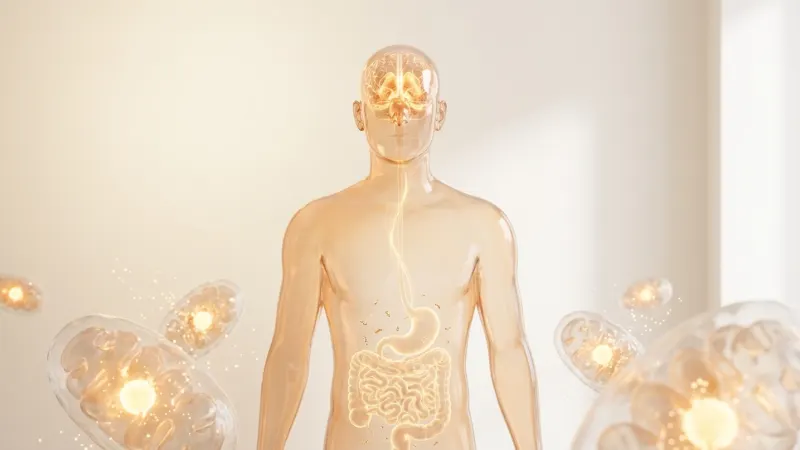
- Gut bacteria: the diet changes the gut's bacteria, and the gut and the brain affect each other. In people with epilepsy, one group of gut bacteria seems to increase in those the diet helps. Whether the same holds in depression is not known.
What does this mean in practice?
It is important to be clear that these results do not mean keto should replace standard treatment for depression. The trial looked at the diet as a supplement to the treatment participants were already getting.
What can you take away?
- Talk to your doctor first: agree on the change in diet with your doctor or psychiatrist, especially if you take medication. Lithium, MAOIs, SSRI or SNRI antidepressants and antipsychotic medication each need their own precautions on keto.
- Weight loss hardly explains it: in the Oxford trial, the diet was set up to keep weight stable. What does explain the effect is not yet known. The researchers themselves note that the free prepared meals may have made daily life easier and so affected mood.
In brief
The research points in an interesting direction. In the Oxford trial, keto gave a small extra improvement on top of usual treatment, and the two meta-analyses of other trials disagree. Long studies are missing, as is knowledge of who benefits most from the diet, and if you take medication for depression, keto requires special precautions.
Who is this for?
Treatment-resistant depression is a serious condition, and the research on keto is new and uncertain. Keto belongs in the clinic, not in a do-it-yourself experiment, so agree on it with your psychiatrist, and never stop medication on your own. Pay particular attention to the following:
- Acute crisis with suicidal thoughts: Call or text 988, which is open 24/7, or call 911 right away. A diet experiment is not an emergency treatment.
- Signs of mania: If you sleep much less than usual without feeling tired, have unusually high energy, or your thoughts race during your first months of keto, contact your doctor or psychiatrist the same day. This is called hypomania, or mania in its more severe form. In a collection of case histories (Frontiers in Nutrition, 2026), 9 people developed hypomania or mania within two months of starting keto, 7 of them without a prior bipolar diagnosis. It applies even if you have never had bipolar disorder.
- Lithium (a mood-stabilizing medication for bipolar disorder): Your kidneys get rid of lithium along with salt, so the salt loss in the first weeks of keto can change your lithium level. Start only with your psychiatrist's agreement, and have the level checked.
- MAOIs (an older type of antidepressant): Aged cheeses, salami, fermented foods and soy and fish sauce can contain tyramine, a substance that together with the medication can cause dangerously high blood pressure. Stick to the food list you were given.
- SSRI or SNRI antidepressants can cause too little sodium (salt) in the blood, especially in older people and people with low body weight, and the salt loss at the start of keto pulls the same way. Headache and nausea can be signs of it, so have your sodium checked, and contact your doctor the same day if you become confused.
- Antipsychotic medication (such as olanzapine, clozapine or quetiapine) often raises blood sugar and cholesterol. Keto can lower blood sugar but raise LDL cholesterol, the type of cholesterol that can build up in your arteries, so have your doctor follow both with blood tests. If you take clozapine, contact your doctor about constipation, which both the medication and keto can cause.
- Valproate, topiramate and zonisamide (for epilepsy, bipolar disorder or migraine): Together with keto, valproate can cause a shortage of carnitine, a substance your body uses to burn fat, and affect the liver, and both keto and topiramate or zonisamide can cause kidney stones and acid buildup in the blood. This needs blood tests and a plan from your doctor.
- Diabetes medication: Insulin and sulfonylureas (tablets that make the pancreas release more insulin) can cause low blood sugar on keto, and SGLT2 inhibitors (such as Jardiance and Farxiga) can cause ketoacidosis, a dangerous buildup of acid, even with normal blood sugar. Agree on your diet with your doctor before you start.
- Bipolar disorder, schizophrenia or another psychotic disorder: Keto is being studied in these conditions, but it belongs only under psychiatric supervision.
- A current or past eating disorder: Doing keto on your own is not advised. Seek help from a professional.
- Pregnancy and breastfeeding: Keto is not advised. Depression in pregnancy needs specialist treatment.
- Children and teenagers under 18: A ketogenic diet for children belongs under medical supervision, for example for epilepsy. A growing body should not be put on keto without it.
- Liver or kidney failure and certain rare inherited diseases: Keto is not advised.
- Anxiety: Keep an eye on how you feel during the start-up phase, and get enough salt and fluids. If you have kidney disease or take blood pressure medication or diuretics (water pills), agree on the amount with your doctor.
For otherwise healthy adults with mild or early depression, lifestyle steps (exercise, sleep, social contact and perhaps a change in diet) can be a good first move. For moderate to severe or treatment-resistant depression, evidence-based psychiatric treatment is the first choice.
Related Reading
Keto, brain and mental health connect in several ways:
- Ketogenic diet for depression: small pilot study shows promising but preliminary results covers a small Canadian study without a control group in adults with moderate to severe depression.
- Can intermittent fasting strengthen your brain? covers fasting and the brain chemical BDNF, where most findings come from animal studies.
- A guide to keto, fasting and the brain: depression, memory and focus brings together what research knows about keto, fasting and the brain, and who needs to be careful.