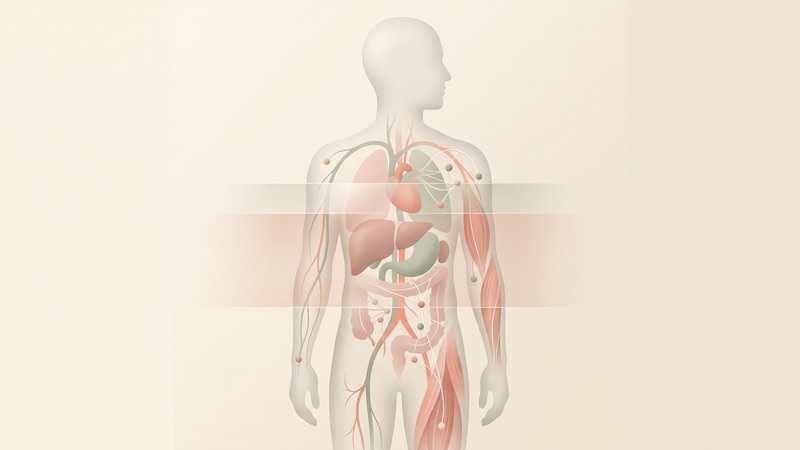
Most of us think of fasting as something to do with weight. But when researchers tracked around 3,000 blood proteins day by day through a seven-day fast, it turned out the body performs a far larger reorganisation than that. And that it does not begin until after three days.
The question the researchers asked: What actually happens in the body during a longer fast, beyond weight loss? Earlier studies measured individual hormones or markers one at a time. This group wanted to see the whole picture at once.
How they investigated it: Twelve healthy volunteers, five women and seven men, completed a seven-day water-only fast. Blood was drawn before the fast, every day during it, and after eating resumed. In each sample the researchers measured around 3,000 different proteins, a method called proteomics, meaning the mapping of every protein in a sample at once.
What they found: Around one third of all measured proteins changed markedly, and the changes came from many of the body's major organs. But the characteristic shifts only appeared after the third day. Participants lost an average of 5.7 kg. After three days of resumed eating, the fat loss remained while lean mass had almost fully returned.
In short: A longer fast sets off a reorganisation across the whole body, not just in the fat stores, but only from around the third day. This article covers what the researchers measured, why the timing is interesting, and what the finding does not say.
What is a protein, and why can the body be read in them?
To see why measuring 3,000 proteins is a big deal, it helps to know what a protein actually is. Your genes are the recipe. Proteins are what the recipe produces, and they do very nearly all the work in the body. Muscle fibres, digestive enzymes, antibodies and the hormone insulin are all proteins.
Four kinds of work proteins do
Cells release proteins into the blood continuously, and more escape when tissue is working, rebuilding or under strain. That makes the blood a kind of noticeboard for what is going on around the body. If a protein made almost only in the liver rises, that says something about the liver.
This is the whole point of measuring three thousand at once. You do not need to know in advance which protein is the interesting one. Instead you get a pattern, a fingerprint of what the entire body is doing right now. An ordinary blood test measures a handful of markers a doctor decided in advance to look for. Here the researchers looked at everything, every day.
The most detailed look inside a fasting body so far
In March 2024 Pietzner and colleagues published a study in Nature Metabolism, carried out by researchers at Queen Mary University of London and the Norwegian School of Sport Sciences.
What makes the study notable is not the number of participants, which is small, but the resolution. By measuring around 3,000 proteins daily, the researchers could see not just whether the body changes, but when, and which organs are involved.
The study in numbers
| Participants | 12 healthy (5 women, 7 men) |
| Type of fast | Water only, 7 days |
| Measurements | Around 3,000 plasma proteins, daily |
| Changed markedly | About one third |
| Trajectory patterns | 9 distinct |
| Average weight loss | 5.7 kg |
| After 3 days of eating | Fat loss kept, lean mass almost back |
| Control group | None |
Nine different patterns
The researchers found the proteins did not respond alike. They fell into nine distinct trajectory patterns: some rose early and fell back, others changed only late, and some kept moving throughout the week.
That is worth noting, because it shows fasting is not one process but several, running at different speeds. The idea that the body "switches into fasting mode" at one particular moment does not quite hold.
Why day three is the interesting number
The fuel switch itself, where the body moves from burning sugar to burning fat, happens within the first two to three days. That is well established, and we describe the mechanism in How the body switches from sugar to ketones when you fast.
But the broader protein changes did not follow that switch. They came later, from around the third day, and they involved tissue with nothing to do with energy.
Senior author Claudia Langenberg put it this way: the results point to effects of fasting beyond weight loss, but these were only visible after three days.
What happens when during a seven-day fast
The most surprising finding
The fasting signature was especially pronounced among proteins from the extracellular matrix. That is the scaffolding of proteins sitting between cells, holding tissue together: connective tissue, cartilage, bone and the brain's supporting structure.
Among the most striking changes was tenascin-R, a protein found almost exclusively in the brain, where it forms part of the structure surrounding nerve cells.
It is not a finding anyone would have predicted from a metabolic perspective. It says something about fasting affecting tissue types that have nothing to do with energy. What it means for health, the study cannot answer — it measures the change, not the consequence.
The nuance about muscle mass
One of the most common arguments against longer fasts is that you lose muscle. The study offers a more nuanced answer.
Participants lost 5.7 kg over the week, and the loss included both fat and lean mass. Lean mass covers muscle, but also water, glycogen (the body's sugar store, which binds water) and organ tissue.
The interesting part happened afterwards. Once participants had eaten normally for three days, the fat loss was still there, while lean mass had almost fully returned. On average 0.69 kg of lean mass was still missing, against 3.6 kg lost during the fast itself.
That fits what you would expect if a large share of the so-called muscle loss was in fact water and emptied sugar stores. It does not mean longer fasts carry no risk to muscle — but it does mean the number on the scale during a fast cannot be read as permanent loss of muscle tissue.
What the study does not show
Precision matters here, because it is easy to read more into a result like this than it contains.
- It is twelve people. Healthy, and with no control group eating normally. The findings are descriptive, not proof of an effect.
- It measures change, not benefit. That a third of the proteins shift does not in itself say whether this is good or bad for long-term health.
- It says nothing about how long one should fast. That changes begin at day three is not the same as a recommendation to fast for three days.
- There is no follow-up. We do not know whether the changes persist, or fade again after a few weeks.
What you can take from it
The finding has one practical consequence worth knowing if fasting interests you.
Fasting for 24 or 36 hours gives you the fuel switch and the changes that come with it. But the broader reorganisation this study describes never gets started. Shorter and longer fasts are therefore not the same thing in different amounts.
That does not make long fasts the better choice. Risk rises with duration too, and longer fasts are not safe for everyone with an illness either. The authors themselves point to fasting-mimicking interventions as a possible route for patients who cannot complete a long fast. It is precisely why part of the research in this field is aimed at finding something that could produce similar effects without the fast.
Important note on safety
Fasts lasting several days are not harmless, and they are not for everyone: pregnant and breastfeeding women, children and adolescents, and anyone with a history of an eating disorder should not fast for several days. If you take insulin or a sulfonylurea (for example glimepiride or glipizide), a long fast can cause dangerously low blood sugar, and if you take an SGLT2 inhibitor (for example empagliflozin or dapagliflozin), the risk of ketoacidosis rises, so the medication must be adjusted or paused by your doctor beforehand. Blood pressure medication and diuretics also require medical assessment because of salt and fluid loss. The most serious complication arises not during the fast but when eating resumes.
If you are considering a longer fast, talk to your doctor first. We have gathered what the research shows about risks, contraindications and what nobody yet knows in the guide to prolonged fasting.
Conclusion
The study is the most detailed look so far into what happens inside a fasting body, and it points to a reorganisation reaching well beyond fat burning. But it is twelve people without a control group, and it measures changes rather than health gains. The strongest part of the finding is the timing: that the body only begins doing something qualitatively different around the third day.