
What is intermittent fasting?
Intermittent fasting, also called time-restricted eating when you do it daily, means alternating between fixed periods of eating and not eating, for example 16 hours without food and 8 hours with. It is not a new fad but one of the most natural physiological processes in the human body.
Over the past few decades, research has shown that intermittent fasting can help you lose weight. In animal studies it also affects the brain: it increases neuroplasticity, the brain's ability to form new connections, and BDNF, a protein that helps brain cells grow and connect. This has not been shown in humans, and short fasts do not make thinking measurably sharper. Animal studies even show extended lifespan, but that has not been documented in humans.
But before you jump on the fasting bandwagon, it is important to understand how it works, which methods exist, and how to start the right way. If you are completely new, nervous or skeptical, this is a good place to start.
The different forms of fasting
16:8: The classic introduction method
16:8 means you fast for 16 hours and eat within an 8-hour window. It is the most popular method for beginners, and for good reason.
How it works: Skip breakfast. Eat your first meal at noon and finish your last meal at 8 pm. It is that simple. You are already on your way.
Who it suits: People with traditional work schedules, those who do not love breakfast, or those who want to try fasting without it becoming overwhelming.
Benefits: Simple to understand and not too extreme. Hunger eases for most people after a few days. The measurable results in the studies build over weeks to months, and the clearest effects show up in trials of twelve weeks or more.
18:6 and 20:4: For the more experienced
Once your body is used to 16:8, you can experiment with longer fasting periods. 18:6 means an 18-hour fast with a 6-hour eating window. 20:4 is even more extreme, only 4 hours a day to eat.
18:6 suits: People who work from home or have flexible schedules. You eat, for example, between 1 pm and 7 pm.
20:4 (Warrior Diet): More aggressive, but it can deliver faster results for experienced fasters.
OMAD: One Meal A Day
Exactly what it sounds like: you eat only once a day. It is a very aggressive form of fasting and is not recommended for beginners.
Typically only 1-2 hours to eat.
Requires a lot of discipline and can lead to nutrient deficiencies if it is not planned carefully.
Works best for experienced fasters or people with a stable, healthy relationship with food.
5:2 diet: A flexible alternative
Eat normally 5 days a week and limit your calories on the other two days: about 500 kcal for women and 600 kcal for men. If you take insulin, a sulfonylurea (a tablet that makes the pancreas release more insulin), or an SGLT2 inhibitor (such as Jardiance or Farxiga), do not add fasting days until your doctor has adjusted your dose, because 500-600 kcal is enough to trigger low blood sugar or ketoacidosis, a dangerous buildup of acid in the blood.
Benefits: Less psychological strain than daily fasting. You only "fast" two days a week.
Drawbacks: The fasting days can be tough, and some people end up overeating the day after.
Extended fasting: For advanced practitioners
Fasting for 24-72 hours or longer should not be attempted as a beginner. Prolonged fasting is not advised at all with type 1 diabetes or insulin treatment, with active cancer, or over the age of 75. Save it for later once you understand how your body responds to fasting. When you are ready, we have a guide to prolonged fasting that walks through the research.
What happens in your body during a fast?
Hours 0-12: Glycogen depletion
During the first 12 hours, your body lives on the sugar your liver has stored as glycogen. (Muscles have their own glycogen store, but it can only be used by the muscle itself and is not emptied by a fast.) That is why you might feel a little tired or crave sugar after 8-10 hours without food, your glycogen stores are running low.
Your insulin drops gradually during this period, which signals your body to start looking for an alternative energy source. Read how fasting changes your hunger and fullness hormones.
Hours 12-18: The fat-burning phase begins
This time window is the "sweet spot" for fat burning. Your liver glycogen is nearly used up, and your body now draws a growing share of its energy from fat tissue. Ketones begin to form, a fuel the brain can use instead of sugar.
In a randomized trial of 122 people (Journal of Health Psychology, 2026), in which half skipped breakfast and fasted 16 hours a day for ten days, the fasters did as well on tests as the others. They did, however, feel less focused in the morning while fasting than in the afternoon after they had eaten, and this held throughout the trial. What you can realistically expect is covered in our guide to keto, fasting and the brain.
Read more about this in our article: The metabolic switch: What happens in your body when you fast?
Hours 18-24: Autophagy rises (in animal studies)
Autophagy, the body's clean-up of old and damaged cellular material, runs at a low level all the time. Animal studies suggest it ramps up markedly during longer fasts, but whether or when that happens in humans has not yet been shown. It is this process that animal studies link to healthy aging, better brain health, and reduced inflammation. Autophagy is not unambiguously good: it protects before a cancer cell arises, but it can help an already established tumor survive. If you have active cancer, fasting should only happen together with your oncology team.
Read more: Intermittent fasting, autophagy, and cancer: What does the research say?
How to start: Step by step with 16:8
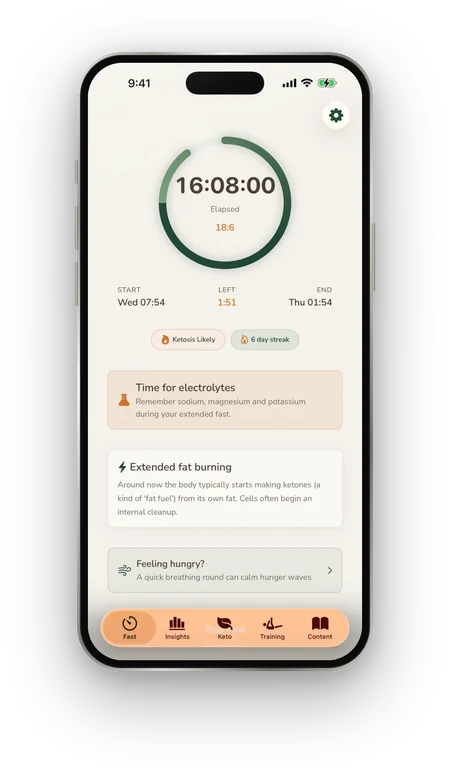
This plan uses 16:8, because it is the easiest to stick with and because the other methods are simply extensions of it. If you are pregnant or breastfeeding, under 18 or over 75, or underweight, have diabetes, kidney disease, cancer or bipolar disorder (in which depression alternates with periods of abnormally elevated mood), have a history of disordered eating, or take medication, read the section "Who should not fast?" further down first. The hardest part at the start is not the hunger but keeping track of the hours. The app below counts your fast down and tells you when your eating window opens.

Weeks 1-2: Start with 16:8, skip breakfast
Drink coffee, tea, or water in the morning. Caffeine can give fat burning a modest nudge, mostly while you are sitting still, which is exactly what you are doing on a fasting morning. The effect was smaller during exercise, and the difference disappeared in the studies that tested both conditions in the same people. If you have a heart rhythm disorder, take lithium (a medication for bipolar disorder), or are pregnant (no more than 200 mg of caffeine a day), talk to your doctor about coffee.
Eat your first meal at noon.
Then eat normally until 8 pm.
Sleep and repeat.
If 16 hours is too much at first, start at 14 hours and build up.
Week 3: Extend to 18:6 if the morning hunger is gone
Eat between 1 pm and 7 pm (or 11 am and 5 pm, whatever fits your schedule).
Now you are truly fasting for 18 hours.
Your hunger may return in the morning, but it comes in waves and usually passes again on its own.
If concentration matters most to you, stay at 16:8. In a meta-analysis, a pooled analysis of trials with 3,484 healthy adults in total (Psychological Bulletin, 2025), test scores dropped slightly with longer fasts and in younger participants.
Week 4 onwards: Stay, or try 20:4
You can now choose: stick with 18:6 or try 20:4.
Listen to your body. If 18:6 works perfectly, stick with it! There is nothing wrong with staying here.
If you want to go further, shorten the eating window by one hour at a time, for example 1 pm to 6 pm and later 1 pm to 5 pm. Leave 20:4 until 18:6 has felt easy for a few months.
Tips for success
Salt: If you combine fasting with keto, or fast longer than 18-24 hours, your body excretes more salt and fluid. Add salt to your food: about 1-2 grams of extra sodium a day at the start, roughly ½ to 1 teaspoon of salt, is a rule of thumb for healthy adults, not a number from trials. If you have kidney disease, heart failure, or high blood pressure, or take a diuretic or lithium, clear the salt with your doctor first.
Magnesium: If you take a magnesium supplement, stay at 100-250 mg in the evening. The US upper limit for magnesium from supplements is 350 mg a day. If you have kidney disease, take magnesium only after clearing it with your doctor.
Headaches during a fast: Headaches and fatigue can be caused by fluid and salt loss, so try a large glass of water with ½ teaspoon of salt (about 1,100 mg of sodium) before assuming it is hunger. If the salt warning above applies to you, ask your doctor first. You can read more about electrolytes, your body's salts such as sodium, potassium and magnesium, in our complete electrolyte guide.
Break your fast the right way: Your first meal should be high in protein and nutrient dense, for example eggs, fish, or chicken with vegetables. Avoid breaking your fast with sugar or fast carbs, as this can cause a blood sugar crash and make you hungrier. Your body needs proper nutrition after the fasting period.
Who should not fast?
Fasting is not for everyone. If you belong to any of these groups, talk to a doctor before you start:
- Pregnant or breastfeeding: Your body needs consistent nutrition.
- Under 18 years old: Growth hormones are important during this period.
- Previous eating disorder: Fasting can reactivate old patterns and is generally not recommended. Talk to your doctor or therapist first.
- Type 1 diabetes: Fasting can cause dangerous blood sugar swings.
- Type 2 diabetes on blood-sugar-lowering medication: Insulin, sulfonylureas and SGLT2 inhibitors can cause dangerously low blood sugar or ketoacidosis (a dangerous buildup of acid in the blood, even with normal blood sugar) during fasting and on keto. Doses often need adjusting, so always talk to your doctor first.
- Underweight or undernourished: Get back to a healthy weight first, and talk to a doctor.
- Certain medications: Some medications need to be taken with food.
- SSRI or SNRI antidepressants can cause too little sodium (salt) in the blood, especially in older people and people with low body weight, and the salt loss during fasting and at the start of keto pulls the same way. Headache and nausea can be signs of it, so have your sodium checked, and contact your doctor the same day if you become confused.
- Blood pressure or diuretic medication: Fasting lowers blood pressure, and extra salt or diuretics can cause dizziness and shifted blood salts. Your doctor needs to adjust the dose.
- Reduced kidney function: Do not take extra potassium or magnesium without clearing it with your doctor.
- Lithium (a mood-stabilizing medication for bipolar disorder): Your kidneys get rid of lithium along with salt, so the salt loss during a fast and extra salt in your food can change your lithium level. Start only with your psychiatrist's agreement, and have the level checked.
- Signs of mania: If you sleep much less than usual without feeling tired, have unusually high energy, or your thoughts race during your first months of keto or fasting, contact your doctor or psychiatrist the same day. This is called hypomania, or mania in its more severe form. It applies even if you have never had bipolar disorder.
- Bipolar disorder: In a small pilot study without a control group (International Journal of Neuropsychopharmacology, 2000), researchers followed 20 people with bipolar disorder on lithium who fasted during Ramadan, when people neither eat nor drink during daylight hours. Of these, 45% relapsed, most of them into mania. The relapses were not related to their blood lithium level, and the researchers themselves point out that Ramadan also changes people's daily rhythm. If you have bipolar disorder, talk to your psychiatrist before you start fasting.
- GLP-1 medication (semaglutide, liraglutide): Too little food combined with too little fluid causes nausea and dehydration. Agree on fasting with your doctor.
- Active cancer: Fast only in agreement with your oncology team, and fasts longer than 24 hours are not advised.
- Over 75: Longer fasts are not advised.
What can you drink during a fast?
Yes: these do not break the fast
Water (any amount)
Black coffee (no cream or sugar)
Tea (black, green, white, or herbal tea)
Diet soda (does not break the fast calorie-wise, but artificial sweeteners can trigger hunger in some people, so test what works for you)
Gray zone: use your judgment
Bone broth: A cup typically contains 30-50 calories, almost all of it protein, and it produces a real insulin response. It technically breaks the fast, but many people use it anyway because it delivers sodium.
Green powder or green juice: Same situation, minimal calories, but it can trigger hunger.
No: these break the fast
Milk, cream, or oat milk
Protein shakes
Smoothies (even fruit-based ones)
Honey, agave, or any sugar
Anything with calories technically breaks the "fast"
Common mistakes to avoid
Eating too little within your eating hours: This is the biggest mistake. Many beginners count calories and cut back drastically. Then you get tired and lose muscle. Eat until properly full within your 8-hour window so your body has what it needs during the fast.
Ramping up too quickly: If you are used to eating many meals a day, do not jump straight to OMAD. Going from 3 meals to OMAD in a week is a recipe for failure. Start with 16:8, let your body adapt for a couple of weeks, and then experiment with longer periods.
Ignoring hunger signals: Hunger during a fast is normal and often just habit ("it is 8 in the morning, I should eat breakfast"). But if you are really dizzy, weak, or worried, then it is okay to eat something. Your health comes first.
Not drinking enough water: Dehydration can feel like hunger. Drink to thirst; for most adults that works out to one and a half to two liters of fluid a day on top of what food provides. If you have heart failure or kidney disease, or take a diuretic, agree on the amount with your doctor.
Skimping on sleep: Too little sleep raises the hunger hormone ghrelin and makes fasting noticeably harder. Prioritize 7-8 hours of sleep and the fast becomes much easier to stick to.
Combining fasting with keto
Fasting and a ketogenic diet fit together hand in glove.
Within your eating hours, if you eat a low-carb, high-fat diet (keto), you experience far fewer blood sugar swings. This means:
Less hunger during the fast
A faster transition to ketones
You do not have to do both to see results. If you want to combine them, do not start keto and fasting in the same week. Let your body adjust to one first, so you do not get the salt loss and fatigue from both at once. If you take diabetes medication, lithium, or medication for depression, psychosis or epilepsy, agree on keto with your doctor first. What to watch for with each type of medication is covered in our guide to keto, fasting and the brain. Read more: Intermittent fasting and short-term fasting: A comprehensive overview of biological effects
Frequently asked questions about intermittent fasting
Is intermittent fasting the same as time-restricted eating? Almost. Time-restricted eating is the daily form of intermittent fasting, such as 16:8, where you eat within a fixed window every day. Intermittent fasting also covers patterns like 5:2.
What is 16:8? The most common form of intermittent fasting: 16 hours without calories and an 8-hour eating window, typically from noon to 8 pm.
How fast does it work? Hunger usually eases after a few days. The measurable results in the studies build over weeks to months, not in a single week.
Can I drink coffee while fasting? Yes, black and unsweetened. Water and tea are fine too. Anything with calories breaks the fast.
Do I need to eat keto to fast? No, but the two pull in the same direction: a low-carb diet means fewer blood sugar swings and less hunger during the fast.
Conclusion: You can do this
Fasting works. Really. But it is not magic. It is simply giving your body longer periods without food, so it uses its own fat for energy.
Remember: Fasting should fit into your life, not the other way around. If you have a family dinner or a social event, then join the meal and fast another day. Fasting is a tool, not a prison. The best results come from flexibility and consistency over time, not from following a rigid plan.
Your action list:
Weeks 1-2 (16:8): Skip breakfast, eat from noon to 8 pm.
Week 3: Extend to 18:6, for example 1 pm to 7 pm, if the morning hunger is gone. Otherwise stay on 16:8.
Week 4 onwards: Listen to your body. Stick with 18:6 or experiment with 20:4.
Remember: Consistency beats perfection. If you can do 16:8 three days a week, that is better than giving up entirely.
Drink water, drink coffee, drink tea. These are your secret weapons.
Eat proper food when your fasting period is over, not junk food just because you were hungry.
You can do this. Start now, your future self will thank you.